English
  Français
  Español

Content
- 1 Understanding the Role of Boiler Finned Tubes in Heat Transfer
- 2 Common Types of Boiler Finned Tubes and Their Applications
- 3 Material Selection for Boiler Finned Tubes
- 4 Manufacturing Methods and Their Practical Implications
- 5 Design Factors That Influence Performance
- 6 Installation, Operation, and Maintenance Considerations
- 7 Practical Guidance for Selecting Boiler Finned Tubes
Understanding the Role of Boiler Finned Tubes in Heat Transfer
Boiler finned tubes are engineered components designed to improve heat transfer efficiency in boilers and related thermal systems. By adding fins to the outer surface of a tube, the effective heat transfer area is significantly increased without requiring a larger footprint. This makes finned tubes especially valuable in applications where space is limited but thermal performance demands are high. In practice, they are commonly used in economizers, air preheaters, waste heat recovery units, and industrial boilers operating under demanding conditions.
From an operational perspective, the main purpose of finned tubes is to enhance convective heat transfer between the tube wall and the surrounding gas or air. This allows systems to extract more useful energy from exhaust streams, reduce fuel consumption, and improve overall boiler efficiency. Understanding how finned tubes work and where they provide the most benefit is the foundation for selecting and applying them correctly.
Common Types of Boiler Finned Tubes and Their Applications
Different fin designs are used to match operating conditions, manufacturing constraints, and maintenance requirements. The fin geometry, attachment method, and spacing all influence performance and durability. Selecting the right type is less about choosing the most complex design and more about matching the tube to real operating needs.
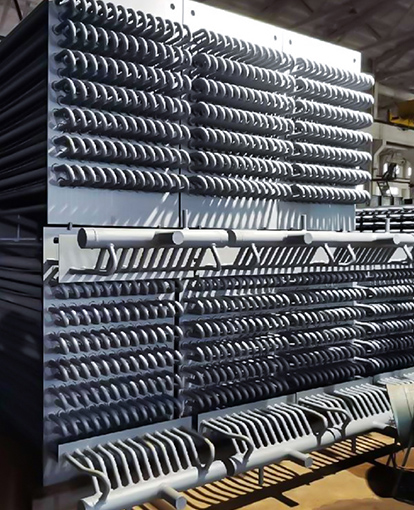
- Helical finned tubes: Fins are wound in a continuous spiral around the tube, providing uniform heat transfer and good mechanical strength. They are widely used in boiler economizers.
- Longitudinal finned tubes: Straight fins run along the length of the tube. These are suitable for applications requiring easy cleaning and lower gas-side pressure drop.
- Studded or pin fin tubes: Short pins or studs are welded onto the tube surface. They perform well in high-temperature and high-fouling environments.
Each type addresses a different balance between heat transfer enhancement, resistance to fouling, and manufacturing cost. Understanding these trade-offs helps avoid overdesign or premature failure.
Material Selection for Boiler Finned Tubes
Material choice directly affects service life, heat transfer performance, and maintenance frequency. Boiler finned tubes often operate in environments involving high temperatures, corrosive flue gases, and thermal cycling. As a result, both the base tube and the fin material must be carefully matched to operating conditions.
| Material | Typical Use Case | Key Consideration |
| Carbon Steel | Standard industrial boilers | Cost-effective, limited corrosion resistance |
| Alloy Steel | High-temperature sections | Improved strength and oxidation resistance |
| Stainless Steel | Corrosive flue gas environments | Higher cost, longer service life |
In some designs, fins and tubes are made from different materials to balance cost and performance. This approach requires reliable bonding methods to prevent thermal resistance or mechanical separation during operation.
Manufacturing Methods and Their Practical Implications
The way fins are attached to the tube has a direct impact on heat transfer efficiency and durability. Poor bonding can introduce thermal resistance, while overly complex processes may increase cost without meaningful performance gains.
Common manufacturing techniques include high-frequency resistance welding, extrusion, and brazing. High-frequency welding is widely used because it produces a strong metallurgical bond and consistent fin geometry. Extruded finned tubes offer excellent thermal contact but are typically limited to non-ferrous materials and lower operating temperatures.
From a maintenance standpoint, manufacturing quality is just as important as design. Uniform fin spacing, proper weld penetration, and controlled tolerances help ensure predictable performance and reduce the risk of localized overheating or vibration-related damage.
Design Factors That Influence Performance
Several practical design parameters determine how well boiler finned tubes perform in real systems. Fin height, thickness, and spacing must be optimized rather than maximized. Excessively dense fins may increase heat transfer area but can also trap ash and raise pressure drop.
- Fin spacing should allow sufficient gas flow and minimize fouling.
- Fin thickness must balance mechanical strength with thermal responsiveness.
- Tube diameter selection affects internal fluid velocity and heat transfer coefficient.
Effective design considers these factors together, using operating data rather than assumptions. This approach leads to stable performance over the full service life of the boiler.
Installation, Operation, and Maintenance Considerations
Even well-designed boiler finned tubes can underperform if installation and operation are not handled carefully. Proper alignment during installation prevents mechanical stress and ensures even gas flow across the tube bank. During operation, monitoring flue gas temperature and pressure drop helps identify early signs of fouling or degradation.
Maintenance practices should be adapted to the fin design and fuel type. For example, soot blowing intervals may differ between helical and longitudinal finned tubes. Regular inspection allows operators to address minor issues before they affect efficiency or safety.
Practical Guidance for Selecting Boiler Finned Tubes
Selecting boiler finned tubes is best approached as a practical engineering decision rather than a catalog choice. Start with accurate operating data, including temperature ranges, gas composition, and maintenance constraints. Then match fin type, material, and manufacturing method to those conditions.
By focusing on realistic performance requirements and long-term reliability, boiler finned tubes can deliver consistent efficiency gains without unnecessary complexity. This practical mindset ultimately supports safer operation, lower fuel costs, and more predictable maintenance planning.