English
  Français
  Español


Content
What an HRSG Actually Does
A gas turbine exhausting at 500–600°C is throwing away roughly a third of the fuel energy it just burned. A heat recovery steam generator systems for industrial and power applications sits directly in that exhaust path and converts wasted thermal energy into usable steam — no additional fuel required. In a combined-cycle power plant, that single step pushes overall efficiency from the low 30% range of a simple gas cycle to well above 60%.
The mechanism is straightforward: hot exhaust gases flow across a series of tube bundles. Feedwater enters at the cold end, absorbs heat progressively as it moves through the unit, and exits as high-pressure superheated steam ready to drive a steam turbine or supply a process. The HRSG is the thermal bridge between two otherwise separate power cycles.
Inside an HRSG: Three Heat Transfer Stages
Every HRSG — regardless of pressure configuration — passes feedwater through the same three functional stages, each targeting a specific temperature band in the exhaust stream.
- Economizer: The first heat exchanger feedwater encounters. It raises the water temperature close to saturation point without boiling it, recovering energy from the cooler tail-end exhaust. A well-designed economizer integrated into the HRSG tail end can reduce stack exit temperatures to below 100°C, wringing out the last recoverable BTUs.
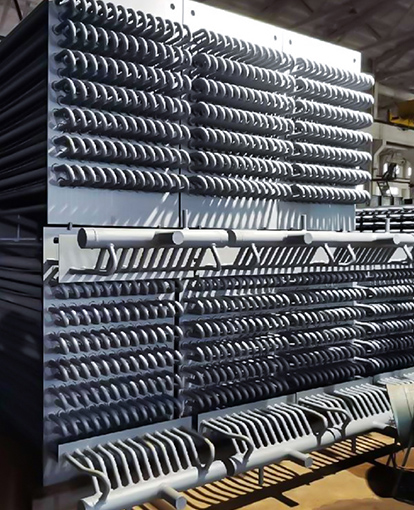
- Evaporator: Water enters as a saturated liquid and exits as saturated steam. This is where the bulk of latent heat transfer occurs, using the mid-temperature exhaust band. Finned tubes are standard here to compensate for the relatively low heat transfer coefficient on the gas side.
- Superheater: Located closest to the hot inlet, it takes saturated steam and raises its temperature further — adding sensible heat without phase change. The result is dry, superheated steam at the parameters the downstream turbine requires.
Pressure Configurations and Efficiency Benchmarks
Choosing how many pressure levels your HRSG operates at is one of the most consequential design decisions you'll make. The difference is measurable in efficiency points — and in revenue over a plant's operating life.
| Configuration | Typical Net Efficiency | Best Fit |
|---|---|---|
| Single-pressure | ~50–54% | Smaller industrial plants, space-constrained sites |
| Dual-pressure | ~55–58% | Mid-scale CCGT, adds 2–4 efficiency points over single-pressure |
| Triple-pressure with reheat | >62% | Utility-scale combined-cycle plants |
According to U.S. EIA data on CCGT efficiency trends, the capacity factor for combined-cycle plants rose from 40% in 2008 to 57% in 2022 — driven largely by the adoption of more advanced turbine and HRSG configurations. Triple-pressure reheat plants sit at the top of that curve.
Horizontal vs. Vertical: Which Layout Fits Your Project
Beyond pressure levels, HRSGs are classified by how exhaust gas flows relative to the tube bundles. The choice affects footprint, maintenance access, and circulation mode.
- Horizontal HRSG (gas flows horizontally across vertical tube banks): natural circulation is easier to implement, which reduces auxiliary power consumption and mechanical complexity. This is the dominant configuration for large utility-scale projects where space is less constrained and long-term maintenance access matters.
- Vertical HRSG (gas flows vertically over horizontal tube banks): a smaller plot footprint and better suitability for forced-circulation systems make this layout common in industrial settings, retrofits, and projects where ground area is limited.
Both configurations achieve comparable overall performance. The selection comes down to site layout, maintenance philosophy, and whether natural or forced circulation better suits the operating profile.
Real Product Specifications: What Power Station HRSGs Look Like
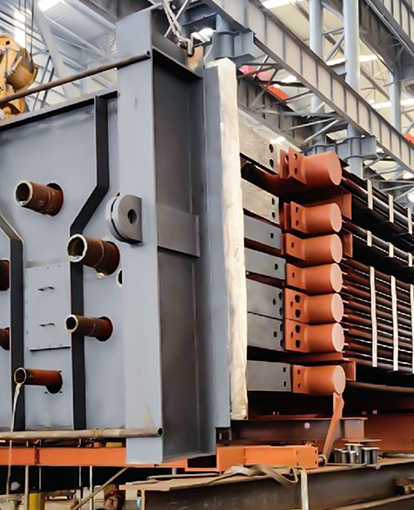
Abstract efficiency numbers mean more when grounded in actual hardware. The table below shows verified design parameters for a power station waste heat boilers engineered for CCGT systems — the kind of specification engineers use during procurement evaluation.
| Parameter | Value |
|---|---|
| Design Pressure | 20.44 MPa |
| Design Inlet Temperature | 280°C |
| Design Outlet Temperature | 314°C |
| Total Heating Area | 15,855 m² |
| Inlet Flue Gas Velocity | 9.74 m/s |
| Outlet Flue Gas Velocity | 8.14 m/s |
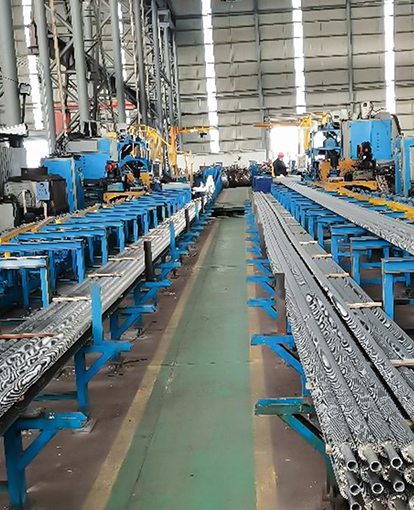
A 15,855 m² heat transfer surface at 20.44 MPa design pressure is not an off-the-shelf component. It demands manufacturing qualifications for pressure parts, rigorous welding procedures, and compliance with standards such as ASME-S — all baseline requirements for utility-class equipment.
Three Questions to Guide Your HRSG Selection
Most HRSG procurement decisions come down to getting the answers to three questions right before requesting quotes.
- What is your exhaust gas profile? Temperature (typically 500–600°C for gas turbines), mass flow rate, and chemical composition all determine heat transfer surface requirements and material choices. Corrosive flue gases — common in waste incineration — require ND steel or equivalent corrosion-resistant alloys throughout.
- What pressure and steam parameters does your downstream process or turbine require? Locking in steam outlet conditions early determines whether a single-pressure or multi-pressure design is justified by the efficiency gain.
- What are your operational flexibility requirements? Plants that start and stop frequently, or follow variable loads, impose higher fatigue demands on pressure parts than baseload units. Modular HRSG designs — where the structure is divided into transportable, pre-engineered sections — simplify installation and allow thermal expansion to distribute across defined modules rather than concentrate at rigid joints.
For process-side applications outside the power sector, industrial waste heat boiler solutions for process industries address the wider temperature variation and fouling tolerance that steel, chemical, and cement operations typically require — a different engineering brief from the cleaner, more stable exhaust conditions of a gas turbine CCGT.
The HRSG adds no fuel cost. Every percentage point of efficiency it recovers translates directly to lower operating cost and lower carbon intensity. Getting the specification right from the start — pressure level, layout, materials, and modular architecture — is what separates a system that performs for 25 years from one that underperforms from day one.