English
  Français
  Español

Content
- 1 How Does an Industrial Boiler Economizer Work?
- 2 Types of Industrial Boiler Economizers
- 3 Quantifiable Efficiency Gains and Fuel Savings
- 4 Additional Benefits: Emissions and Equipment Longevity
- 5 Key Design Considerations for Economizer Installation
- 6 Economizer Maintenance Best Practices
- 7 Typical Industrial Applications
An industrial boiler economizer is a heat exchange device that recovers waste heat from flue gases and uses it to preheat the boiler feedwater. This simple principle delivers a powerful result: for every 40°F (22°C) reduction in exhaust gas temperature, boiler efficiency increases by approximately 1%. In practice, installing an economizer typically improves overall boiler efficiency by 2% to 5%, directly translating to 2-5% fuel savings and a corresponding reduction in emissions.
How Does an Industrial Boiler Economizer Work?
The economizer is installed in the exhaust flue, downstream of the boiler. Hot flue gases flow over a series of tubes through which feedwater passes. Heat transfers from the gas to the water, raising the water temperature before it enters the boiler. This reduces the energy required to turn water into steam, directly improving boiler efficiency.
Basic Heat Transfer Mechanism
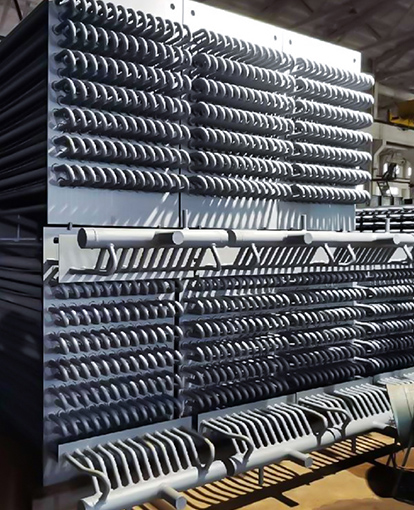
The heat transfer is governed by the temperature difference between the flue gas and the feedwater. A typical arrangement uses finned tubes to increase surface area without increasing footprint. For a natural gas boiler, flue gas entering the economizer may be at 350°F (177°C) and leave at 280°F (138°C), while feedwater is heated from 220°F (104°C) to 290°F (143°C).
Types of Industrial Boiler Economizers
Economizers are categorized primarily by tube configuration and whether they allow condensation. The table below summarizes the most common types.
| Type | Description | Typical Efficiency Gain | Common Applications |
|---|---|---|---|
| Finned Tube | Extended surface with fins welded or wrapped around tubes; compact design for moderate gas temperatures. | 2-3% | Natural gas, light oil; limited space retrofits |
| Bare Tube | Simple tubes without fins; rugged and easy to clean, suitable for dirty fuels. | 1.5-2.5% | Heavy oil, coal, biomass with high particulate |
| Condensing | Cools flue gas below water dew point, recovering latent heat; constructed from corrosion-resistant materials. | 5-8% | Natural gas with low sulfur; district heating |
Quantifiable Efficiency Gains and Fuel Savings
Field data consistently show that economizers deliver measurable returns. For a 200 hp boiler operating 6000 hours per year on natural gas, a 3% efficiency improvement saves approximately 3,000 MMBtu annually, reducing fuel cost by $30,000 at $10/MMBtu. The following list quantifies typical gains:
- Reducing flue gas temperature by 50°F (28°C) increases efficiency by roughly 1.25%.
- A well-designed economizer can lower exhaust temperature from 450°F to 300°F (232°C to 149°C), boosting efficiency by 3.75%.
- Condensing economizers on gas-fired boilers achieve efficiency gains above 90% (HHV) by recovering latent heat.
Additional Benefits: Emissions and Equipment Longevity
Beyond fuel savings, economizers contribute to environmental and operational goals:
- CO₂ reduction is proportional to fuel savings – a 3% efficiency gain cuts CO₂ emissions by 3% for the same steam output.
- Lower flue gas temperatures reduce thermal stress on downstream components and can extend stack life.
- Preheated feedwater reduces thermal shock in the boiler drum, decreasing maintenance frequency.
Key Design Considerations for Economizer Installation
Proper selection and integration require attention to several technical factors:
- Acid dew point: For sulfur-containing fuels, tube wall temperature must stay above the acid dew point to prevent corrosion. This limits how much the gas can be cooled.
- Gas-side pressure drop: Additional resistance may require an induced draft fan. Typical economizers add 0.5 to 2 inches of water column pressure drop.
- Feedwater quality: Treated water is essential to avoid scaling inside tubes. Hard water can quickly foul the heat transfer surface.
- Space and layout: Retrofitting often requires compact designs like finned tubes or multiple-pass arrangements.
Economizer Maintenance Best Practices
Routine maintenance preserves performance and prevents unplanned downtime. Follow these steps:
- Inspect tubes and fins annually for soot accumulation, corrosion, or mechanical damage.
- Clean gas-side surfaces using soot blowers (steam or compressed air) every 3-6 months for dirty fuels.
- Monitor feedwater inlet and outlet temperatures; a declining temperature rise indicates fouling or scaling.
- Check for leaks at tube sheets and gaskets during boiler outages.
Typical Industrial Applications
Economizers are deployed across a wide range of industries where steam or hot water is generated:
- Power generation: Heat recovery steam generators (HRSGs) often include economizer sections to maximize cycle efficiency.
- Chemical processing: Continuous steam demand makes economizers highly cost-effective.
- Food and beverage: Retrofits on fire-tube boilers are common to reduce energy costs.
- Textile mills: High operating hours ensure rapid payback, often within 12-18 months.