English
  Français
  Español


Content
- 1 Direct Answer: What an Economizer Does for a Waste Heat Boiler
- 2 How the Heat Recovery Mechanism Functions
- 3 Quantifiable Fuel Savings and Efficiency Gains
- 4 Flue Gas Temperature Reduction and System Impact
- 5 Comparative Design Configurations
- 6 Critical Selection Parameters and Materials
- 7 Installation Guidelines for Maximum Recovery
- 8 Managing Dew Point and Cold-End Corrosion
- 9 Operational Payback and Financial Logic
Direct Answer: What an Economizer Does for a Waste Heat Boiler
A waste heat boiler economizer is a heat exchanger that captures residual thermal energy from flue gases to preheat boiler feedwater. By recovering heat that would otherwise escape to the atmosphere, it directly reduces the fuel required to convert water into steam. The core result is a typical fuel savings of 5% to 15% and a corresponding rise in overall boiler efficiency, often by 3% to 8%. This preheating step also lessens thermal shock to the boiler drum, contributing to longer equipment life.
How the Heat Recovery Mechanism Functions
Economizers are positioned in the exhaust gas path, after the main evaporator section but before the stack. The feedwater flows through finned or bare tubes while hot gases pass across them, transferring heat without mixing the two streams. The effectiveness of this transfer depends on the approach temperature—the difference between the leaving flue gas temperature and the entering water temperature. Keeping this margin tight, often around 10°C to 20°C, maximizes recovery without risking condensation-related corrosion on the gas side.
Quantifiable Fuel Savings and Efficiency Gains
A well-known operational guideline is that for every 22°C drop in flue gas exit temperature, boiler efficiency increases by approximately 1%. In a heat recovery steam generator operating on a gas turbine exhaust stream at 500°C, adding an economizer can lower the exit gas temperature to 120°C from 250°C. That translates into fuel savings exceeding 5%, cutting thousands of dollars in annual fuel cost per unit. Recent case studies in process industries demonstrate that economizer retrofits commonly achieve a payback period of less than two years.
Flue Gas Temperature Reduction and System Impact
Lowering flue gas temperature directly boosts the system’s thermal efficiency. However, the limit is the acid dew point of the gases. If fuels contain sulfur, cooling below the dew point, typically 120°C to 140°C for many industrial fuels, leads to sulfuric acid condensation and rapid corrosion of tube surfaces. This makes material selection and precise temperature control essential. Modern economizer designs integrate bypass dampers and thermocouple-driven controls to keep gas temperatures safely above the dew point during low-load or cold-start conditions.
Comparative Design Configurations
The specific layout of an economizer affects performance, footprint, and maintenance access. The following table summarizes the common configurations.
| Configuration | Key Trait | Optimal Use Case |
|---|---|---|
| Horizontal Bare Tube | Easier cleaning; heavier | Fouling or ash-heavy exhaust |
| Vertical Bare Tube | Compact footprint | Tight installation spaces |
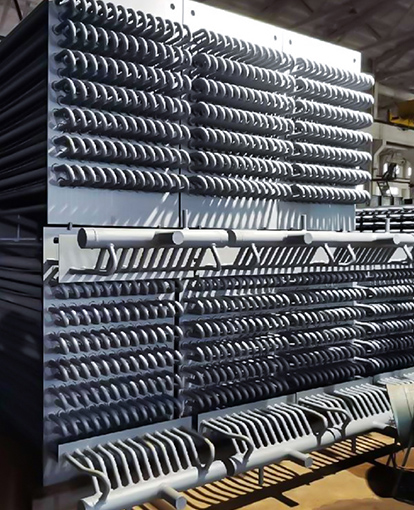
| Finned Tube | Highest heat transfer rate | Clean gas streams |
Finned tubes pack more surface area into a given volume, making them popular for natural gas-fired systems where particulate loading is low. Bare tubes, however, withstand abrasive ash in solid-fuel or waste-incineration exhausts. Horizontal passes allow for inline sootblowers, while vertical coils ease water drainage during shutdown.
Critical Selection Parameters and Materials
Choosing an economizer goes beyond basic thermal sizing. Several operational factors define its long-term reliability.
- Gas-side fouling tendency: High ash or sticky particulate demands wider tube pitches and sootblower integration.
- Water quality: Feedwater with dissolved oxygen accelerates corrosion; tight deaeration control to less than 0.007 mg/L of oxygen is expected.
- Pressure drop constraints: Adding more rows of tubes increases heat recovery but also raises fan or compressor power consumption. An optimal balance keeps gas-side pressure drop under 2.5 to 5 mbar.
- Material grade: Condensation risk at the cold end often necessitates using corrosion-resistant alloys like 316L stainless steel or SA210 carbon steel with a corrosion allowance.
Installation Guidelines for Maximum Recovery
Proper integration determines whether predicted savings materialize. The economizer should sit as close to the boiler gas exit as practical to receive the hottest gases. Flow modulation valves on the water side prevent steaming inside the economizer, which can cause water hammer and mechanical damage. A common safety rule is to ensure the outlet water temperature stays at least 10°C below the saturation temperature corresponding to the boiler operating pressure. When ducting is redesigned, maintaining gas velocity uniformity across the tube bank prevents localized hot spots and uneven thermal expansion.
Managing Dew Point and Cold-End Corrosion
Cold-end corrosion is the dominant failure mode for economizers on sulfur-bearing fuels. Once metal surface temperature falls below the acid dew point, iron sulfates form and rapidly thin tube walls. The primary defense is a feedwater preheater or a recirculation loop that ensures water entering the economizer is above 60°C to 80°C, keeping the tube wall temperature above the critical threshold. For intermittent service, bypass dampers on the gas side are essential to route hot gas away from the cold coils during startup, preventing condensation entirely.
Operational Payback and Financial Logic
The economic case is built on fuel displacement. In a medium-pressure steam system generating 10 tons of steam per hour, a properly sized economizer can recover approximately 0.5 to 0.8 MM kcal/h of heat. Valued against natural gas prices, this energy recovery often equals annual savings of $40,000 to $100,000. Including installation and minor piping modifications, the simple payback period typically ranges from 12 to 24 months. This rapid return, combined with a service life exceeding 15 years when water chemistry and temperature controls are maintained, makes the economizer one of the highest-return efficiency upgrades available for a waste heat system.