English
  Français
  Español


Content
- 1 What Is an Industrial Boiler Economizer and How Does It Work?
- 2 How Much Efficiency Can an Economizer Add?
- 3 Quantifying Fuel Cost Savings
- 4 Types of Industrial Boiler Economizers
- 5 Environmental Benefits: Emissions Reduction Alongside Cost Savings
- 6 Key Design and Installation Considerations
- 7 Maintenance Requirements to Sustain Performance
- 8 Industries That Benefit Most from Economizer Installation
- 9 Conclusion
Rising energy costs and tightening emissions regulations are pushing industrial facilities to squeeze every BTU from their boiler systems. One of the most proven, cost-effective solutions is the industrial boiler economizer — a heat exchange device that captures waste heat from flue gases and redirects it to preheat incoming feedwater. The result is less fuel burned for the same steam output, lower operating costs, and reduced carbon emissions.
This guide explains how economizers work, how much efficiency they realistically deliver, what different types are available, and what factors determine installation success.
What Is an Industrial Boiler Economizer and How Does It Work?
An economizer is installed in the exhaust flue path, downstream of the boiler's main combustion section. As hot flue gases travel toward the stack, they pass over a series of tubes through which cold feedwater flows. Heat transfers from the gas to the water, raising the feedwater temperature before it enters the boiler drum. Because the water arrives at a higher temperature, the boiler requires less fuel energy to convert it into steam.
To understand how the economizer works on a boiler in practical terms, consider a typical natural gas installation: flue gas enters the economizer at around 350°F (177°C) and exits at roughly 280°F (138°C), while feedwater temperature rises from approximately 220°F (104°C) to 290°F (143°C). That 70°F rise in feedwater temperature directly reduces the burner load needed to reach steam conditions.
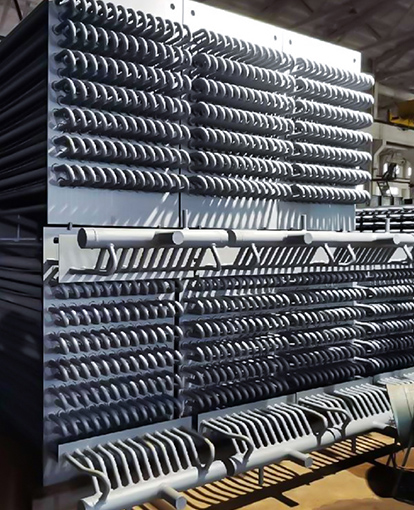
The heat transfer efficiency depends primarily on the temperature differential between the flue gas and the feedwater, and on the total surface area available for exchange. Finned tubes are commonly used to multiply the effective surface area without increasing the economizer's physical footprint — a critical advantage in space-constrained retrofits.
How Much Efficiency Can an Economizer Add?
The efficiency gains are measurable and well-documented. For every 40°F (22°C) reduction in exhaust gas temperature, boiler efficiency increases by approximately 1%. In typical industrial installations, a properly sized economizer improves overall boiler efficiency by 2% to 5%. Condensing economizers — which cool flue gas below its water dew point to recover latent heat as well as sensible heat — can push natural gas boiler efficiency above 90% (HHV basis), compared to 78–82% for a standard boiler without heat recovery.
A few benchmark figures help illustrate the scale of these gains:
- Reducing flue gas temperature by 50°F (28°C) raises efficiency by roughly 1.25%.
- Lowering exhaust temperature from 450°F to 300°F (232°C to 149°C) with a well-designed economizer yields approximately 3.75% efficiency improvement.
- For every 6°C rise in feedwater temperature, fuel consumption drops by about 1%.
- Installing an economizer can recover 30–50% of the available stack energy loss, which typically represents 18–22% of total input energy in a standard boiler.
Combined with an air preheater, an economizer and preheater system can increase overall thermal efficiency by 3–7%, according to data from industrial power station boiler applications.
Quantifying Fuel Cost Savings
Efficiency percentages translate directly into dollars. For a 200 hp boiler operating 6,000 hours per year on natural gas, a 3% efficiency improvement saves approximately 3,000 MMBtu annually — equivalent to roughly $30,000 in fuel costs at $10/MMBtu. Larger facilities with continuous steam demand see proportionally greater returns.
The table below summarizes typical savings scenarios across boiler sizes:
| Boiler Size | Annual Operating Hours | Estimated Fuel Savings (MMBtu/yr) | Cost Savings (USD/yr) |
|---|---|---|---|
| 100 hp | 6,000 | ~1,500 | ~$15,000 |
| 200 hp | 6,000 | ~3,000 | ~$30,000 |
| 500 hp | 8,000 | ~10,000 | ~$100,000 |
U.S. Department of Energy data indicate that waste-heat recovery systems can cut fuel use by 5–10%, with payback periods often under two years. For high-operating-hour facilities such as textile mills, payback can occur within 12–18 months. One documented case from a Chinese power plant showed that adding an H-fin tube economizer saved 12,000 tons of standard coal annually while cutting CO₂ emissions by 31,000 tons — with a full payback period of just 11 months.
Types of Industrial Boiler Economizers
Not all economizers are built the same. The right type depends on the fuel being burned, available space, flue gas characteristics, and the desired efficiency target.
| Type | Description | Typical Efficiency Gain | Best For |
|---|---|---|---|
| Finned Tube | Extended fins welded or wound around tubes; maximizes surface area in compact space | 2–3% | Natural gas, light oil; retrofit applications |
| Bare Tube | Plain tubes without fins; easy to clean, durable in dirty gas environments | 1.5–2.5% | Coal, biomass, heavy oil with high particulate |
| Condensing | Cools flue gas below dew point to recover latent heat; requires corrosion-resistant materials | 5–8%+ | Natural gas with low sulfur; district heating |
Non-condensing economizers are simpler and more widely applicable across fuel types. They keep the flue gas temperature above its acid dew point, avoiding the risk of corrosive condensate forming on tube surfaces — an important consideration for sulfur-bearing fuels such as heavy oil or coal. Condensing economizers offer the highest efficiency gains but require careful material selection (typically stainless steel or other corrosion-resistant alloys) and are most suited to clean-burning natural gas systems.
In large-scale power and cogeneration applications, economizers are a core section of the HRSG (Heat Recovery Steam Generator), where they preheat feedwater as part of a multi-stage heat recovery cycle.
Environmental Benefits: Emissions Reduction Alongside Cost Savings
Fuel savings and emissions reductions are directly linked — burn less fuel, emit less CO₂. A 3% efficiency gain reduces CO₂ output by 3% for an equivalent steam load. Over a full year of operation, this adds up to significant emission cuts across an entire facility.
Economizers also help reduce nitrogen oxide (NOₓ) and particulate emissions by lowering average combustion temperatures and reducing total fuel throughput. For facilities operating under emissions caps or pursuing carbon reduction targets, the environmental case for economizer installation is as compelling as the financial one.
Key Design and Installation Considerations
Getting the most from an economizer requires careful engineering during the selection and installation phases. Several factors determine whether a unit performs to its rated potential:
- Acid dew point management: For fuels containing sulfur, tube wall temperature must remain above the acid dew point (typically 120–150°C for sulfur-bearing fuels) to prevent sulfuric acid condensation and tube corrosion. This sets a lower limit on how aggressively the flue gas can be cooled.
- Gas-side pressure drop: Economizers introduce flow resistance in the exhaust path. Standard units add 0.5 to 2 inches of water column pressure drop — in some cases requiring an induced draft fan to compensate.
- Feedwater quality: Scaling on the water side from hard or untreated water significantly reduces heat transfer and can damage tubes. Proper water treatment is a prerequisite for sustained performance.
- Sizing and integration: The economizer must be matched to the boiler's capacity, duty cycle, and existing piping layout. Oversizing can cause feedwater to approach saturation temperature, risking steam generation within the economizer tubes.
Maintenance Requirements to Sustain Performance
An economizer that is not properly maintained will lose efficiency over time due to fouling, scaling, and corrosion. The following maintenance schedule reflects industry best practice:
- Inspect tubes and fins annually for soot buildup, corrosion pitting, or mechanical damage.
- Clean gas-side surfaces every 3–6 months for boilers burning dirty fuels, using steam or compressed-air soot blowers.
- Monitor feedwater inlet and outlet temperatures continuously; a declining temperature differential is the earliest indicator of internal fouling or scaling.
- Check tube sheet joints and gaskets during planned boiler outages to detect early-stage leaks.
A monitored, well-maintained economizer can sustain its design efficiency for 15–20 years, providing a long runway of cost savings over its operational life.
Industries That Benefit Most from Economizer Installation
While economizers are beneficial in virtually any facility with a steam or hot-water boiler, certain sectors see disproportionately fast payback due to high operating hours and large fuel spend:
- Power generation: Utility and cogeneration plants use economizer sections inside HRSGs to maximize thermal cycle efficiency.
- Chemical and petrochemical: Continuous, high-pressure steam demand makes economizers highly cost-effective across refineries and processing plants.
- Pulp and paper: Mills with recovery boilers rely on economizers to reclaim heat from high-volume exhaust streams.
- Food and beverage: Dairy, brewing, and canning operations commonly retrofit economizers onto fire-tube boilers to reduce energy costs and improve sustainability metrics.
- Textile manufacturing: Long operating hours mean a typical payback of 12–18 months, making the investment case straightforward.
Conclusion
Industrial boiler economizers are one of the most reliable, lowest-risk investments available for reducing fuel costs and cutting emissions in steam-generating facilities. With typical efficiency gains of 2–5%, fuel savings of $15,000–$100,000 or more per year depending on boiler size and operating hours, and payback periods commonly under two years, the financial case is straightforward. When combined with proper sizing, correct material selection, and a consistent maintenance program, an economizer delivers decades of measurable return.
For facilities evaluating heat recovery options, the starting point is an accurate flue gas temperature audit and feedwater temperature assessment — from there, the most appropriate economizer type and configuration can be matched to the specific application.