English
  Français
  Español


Content
An evaporator concentrating 20,000 kg of water per hour on single-effect duty consumes roughly 22,000 kg of live steam every hour it runs. At typical industrial steam costs of $30-50 per ton, that adds up to a seven-figure fuel bill over a single year of operation. Mechanical vapor recompression (MVR) exists because most of that money buys heat that is thrown away: the vapor boiled off the product carries the same latent heat that was just purchased, and in a conventional train it is condensed against cooling water and vented outside.
The short verdict for anyone evaluating the technology: MVR recompresses that process vapor slightly so it can condense on the heating side of the evaporator and boil more liquid. One kilowatt-hour of compressor electricity then does the evaporation work of roughly 10-25 kilowatt-hours of steam, and live steam demand falls to a trim load of about 0.02-0.05 kg per kg of water evaporated. For continuously loaded evaporators with manageable boiling point elevation, it is the lowest operating-cost evaporation route available.
How Mechanical Vapor Recompression Works
The cleanest mental model is an open-cycle heat pump. Vapor leaving the boiling surface of the evaporator, usually water vapor, enters a compressor instead of a condenser. The compressor raises its pressure from near atmospheric to roughly 1.2-1.5 bar absolute, which lifts the condensing temperature from around 95-100 °C to 105-112 °C. That modest lift is the whole trick: the compressed vapor condenses inside the heating side of the calandria, releasing its latent heat across a small temperature difference to boil more liquid, and the condensate leaves as clean hot water. Beyond heat losses and product preheating, the loop needs no live steam in steady operation; a small auxiliary source covers startup and load trimming.
Compressor Types and Temperature Lift
Compressor selection follows the required lift. Single-stage centrifugal fans handle the large vapor volumes of water evaporation with lifts up to roughly 20-25 K, while twin-screw machines and two-stage fan arrangements extend the range for higher lifts. The lift you need is not a preference: it equals the boiling point elevation of the liquor plus the temperature difference required to push heat across the evaporator surface, so the process chemistry and the heat transfer design set it for you.
Where MVR Delivers Today
The technology is established wherever large volumes of water or solvent must be evaporated continuously and the vapor is reasonably clean:
- Dairy: milk, whey, and permeate concentration, one of the earliest large-scale adopters
- Food and beverage: fruit juice, sugar syrups, and broths
- Pulp and paper: black liquor pre-concentration before the recovery boiler
- Chemical and pharmaceutical: solvent recovery and distillation overhead streams
- Wastewater and zero-liquid-discharge: brine concentration ahead of crystallizers
- Desalination: mechanical vapor compression units for small and mid-size water production
Practical limits still apply. Most commercial systems keep boiling temperatures below roughly 100-110 °C, because compressor materials and shaft seals become expensive beyond that range, and chloride-bearing liquors push wetted parts toward 316L stainless, duplex grades, or higher alloys. The boiling point elevation of the liquor remains the most common reason a proposed MVR project gets redesigned.
What the Numbers Look Like
Conclusion first: when grid power is reliable and steam is expensive, MVR projects typically pay back in one to three years. A single-effect evaporator consumes about 1.1 kg of steam per kg of water evaporated, and even a five-effect train still needs roughly 0.25 kg. An MVR unit replaces most of that with 15-30 kWh of compressor electricity per ton of evaporation, depending on lift. Against steam at $30-50 per ton and power at $0.08-0.12 per kWh, the operating cost per ton of water evaporated falls from $30 or more to roughly $1.5-3.5. For a 10-ton-per-hour plant running 8,000 hours a year, the saving against single-effect operation lands between $2 million and $3 million annually.
Cooling-water demand drops sharply too, because latent heat is recycled instead of rejected. The trade-offs sit on the capital side: a compressor with drive and controls, larger heat transfer area because the driving temperature difference is small, and electrical infrastructure sized for a continuous motor load. The compressor is also a single rotating machine in a critical loop, so spare parts, condition monitoring, and trained maintenance staff belong in the operating budget from day one.
Selection Limits: Where MVR Struggles
Before shortlisting MVR, run these checks in order. Each one has disqualified real projects:
- Boiling point elevation. The compressor must overcome the liquor's BPE plus the heat transfer temperature difference. Once BPE exceeds about 15-20 K, low-lift fans drop out and the choice narrows to screw compressors, thermal vapor recompression, or multi-effect designs.
- Fouling behavior. Small temperature differences and large surfaces leave no margin for fouled tubes. A scale layer that would barely bother a steam-heated calandria can collapse an MVR heat balance, so cleaning-in-place must be part of the design.
- Load profile. MVR earns its savings at steady, continuous duty. Frequent batch cycling, wide turndown, and long shutdowns erode the economics quickly.
- Corrosion and materials. Carryover of salts and acids into the vapor and condensate decides equipment life; material selection and purge management need engineering attention.
- Compressor service. Vibration limits, seal systems, and spare rotor availability should be engineered in, not improvised after the first failure.
MVR, TVR, or Multi-Effect: A Side-by-Side View
MVR is one of three established routes for reusing evaporation vapor. Thermal vapor recompression (TVR) uses a steam-jet ejector as the compressor, trading motive steam for entrained vapor. Multi-effect evaporation (MEE) cascades the vapor through successive stages at falling pressures. The right answer depends less on fashion than on three numbers: your steam price, your power price, and the boiling behavior of the liquor.
| Aspect | MVR | TVR (steam ejector) | Multi-effect (MEE) |
|---|---|---|---|
| Driving energy | Electricity via mechanical compressor | Motive steam via ejector | Live steam in the first effect |
| Steam demand per kg evaporated | 0.02-0.05 kg, trim only | 0.3-0.6 kg, ratio dependent | About 1.1 kg single effect, falling roughly 15% per added effect |
| Reuse of latent heat | Very high, effective COP of 10-25 | Moderate | Moderate, improves with effect count |
| Temperature lift | 10-40 K, compressor limited | Fixed by ejector and motive steam pressure | Distributed across effects |
| Best fit | Continuous duty, low BPE, costly steam, reliable power | Moderate-pressure steam already on site | Cheap steam, unreliable power, batch campaigns |
The routes are also combined in practice. A common configuration heats the first effect with live steam or a TVR ejector and runs the finishing effects on MVR, so the compressor only handles the cleanest, lowest-BPE vapor in the train.
Fitting MVR Into a Plant-Wide Heat Recovery Plan
MVR solves the vapor side of the energy problem, but no evaporator operates alone. An MVR plant still runs a boiler house, dryers, kilns, thermal oxidizers, or process furnaces that discharge hot flue gas around the clock. That gas cannot be recompressed; its heat has to be captured with surface-type equipment.
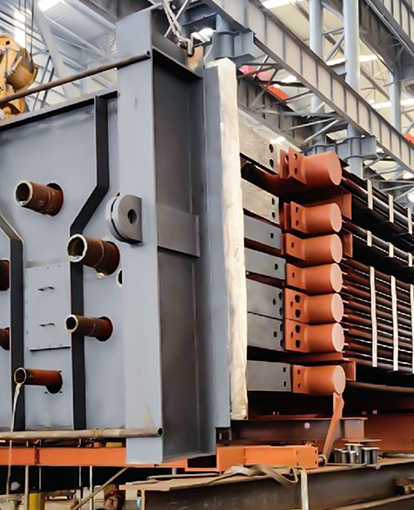
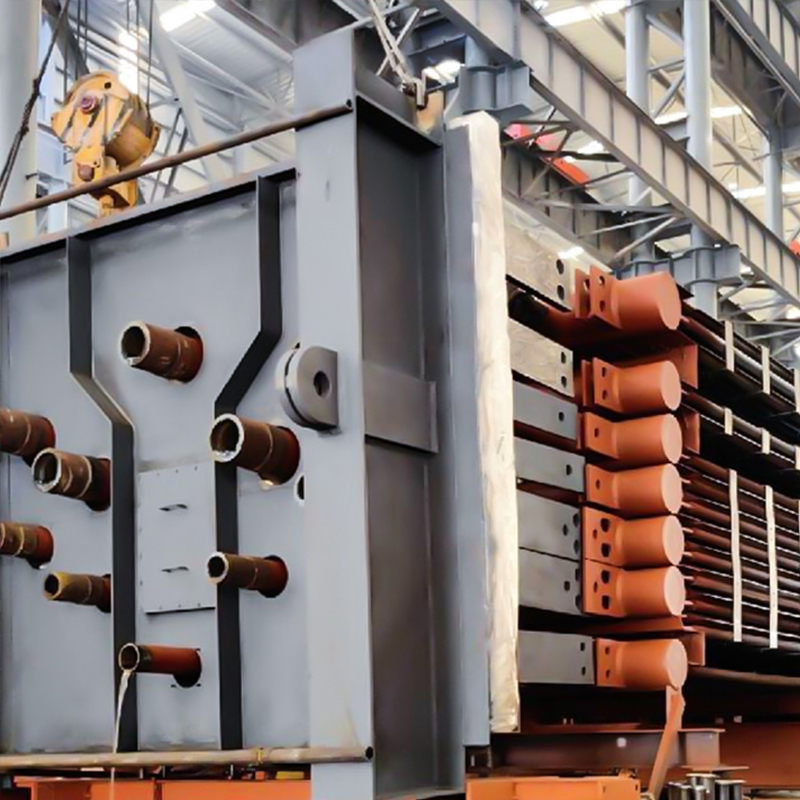 Industrial Waste Heat Boiler for Flue Gas Steam RecoveryRecovering steam from hot process exhaust complements MVR plants, which still run boilers, dryers, and furnaces around the clock. With flue gas capacities up to 320,000 Nm³/h and evaporation rates of 3.8-54.5 t/h, it turns continuous waste heat into usable plant steam.View Product →
Where exhaust carries enough usable energy, an industrial waste heat boiler converts it into steam for the rest of the plant, and our guide to how an industrial waste heat boiler works covers the operating principles in detail. Where the priority is cutting stack temperature and lifting boiler efficiency, a dedicated gas-side economizer recovers the last usable degrees from flue gas before it reaches the stack.
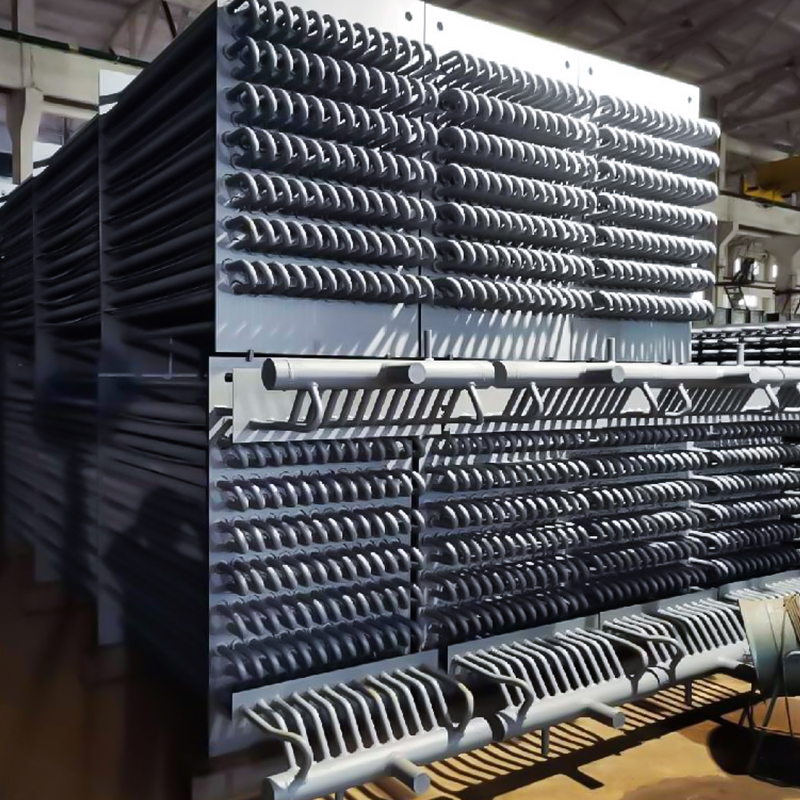 Economizer for Process Equipment Flue Gas Heat RecoveryWhen lowering stack temperature and raising boiler efficiency is the priority, a gas-side economizer captures the last usable degrees before exhaust reaches the stack. Built for corrosive refinery and chemical flue gas at 250-400°C, it preheats feed water with sealed, monitored construction.View Product →
Gas-side performance ultimately depends on the tube surface. Extended surfaces recover more heat from the same volume of flue gas, and H-type finned tubes in particular resist fouling thanks to their aligned, straight gas lanes. Our overview of finned tube types, materials, and efficiency gains walks through the trade-offs engineers weigh when specifying them.
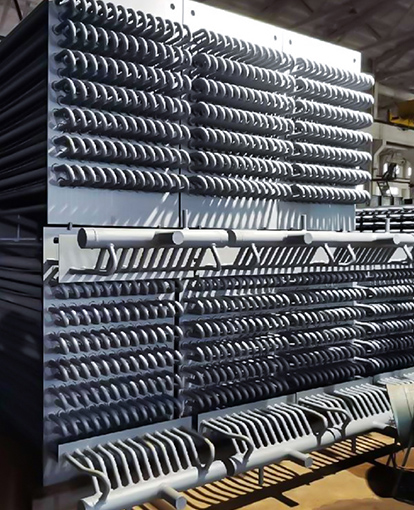
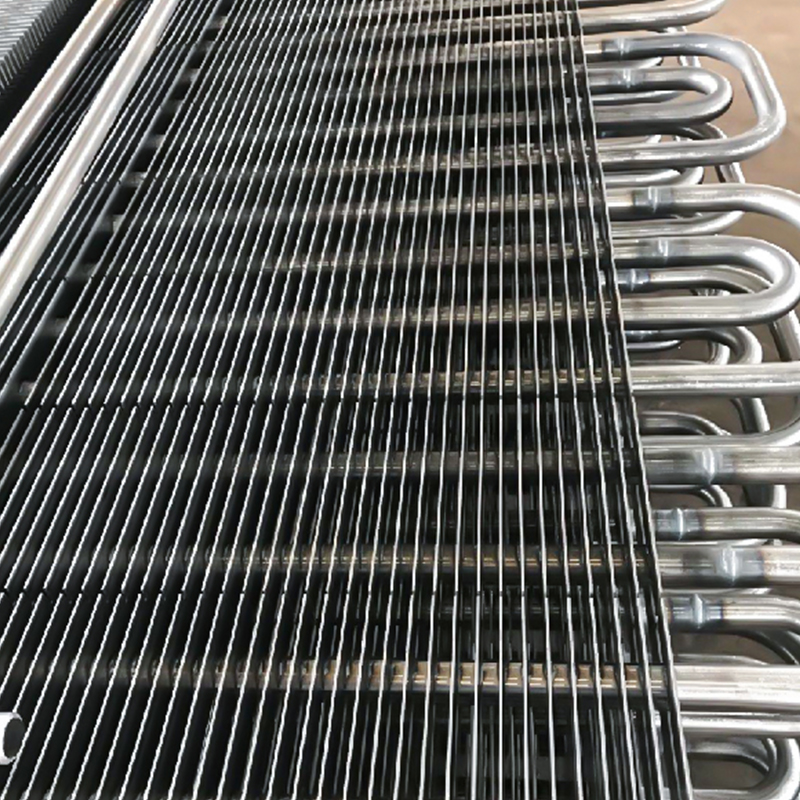 H-Type Finned Tube for Dust-Laden Flue Gas Heat ExchangersGas-side performance depends heavily on tube surfaces. H-type finned tubes enlarge heating area up to 1.5-2 times versus spiral fins, while straight parallel gas lanes resist fouling and clogging, making them well suited to waste heat recovery from dusty exhaust.View Product →
Treating the MVR loop and the gas side as one integrated design prevents the classic mistake of optimizing the evaporator while the boiler stack upstream keeps running hot.
Practical Takeaways for Engineers and Buyers
The decision sequence we recommend is short. Quantify your steam and electricity prices per unit of evaporation. Measure the boiling point elevation of the real liquor, not a diluted lab sample. Confirm the load profile is genuinely continuous. Then design the gas side in the same project, recovering stack and exhaust heat with economizers and waste heat boilers alongside the MVR loop rather than as an afterthought.
For buyers specifying the surrounding heat recovery equipment, manufacturing quality decides whether the calculated savings survive the first overhaul. Pressure parts built to ASME requirements, automated welding lines backed by X-ray real-time imaging, and annual capacity above 20,000 tons for large EPC projects are the standards we work to at Wuxi Jinker Power Equipment, because a heat recovery system is only as reliable as the welds holding it together. Get the process side and the gas side working as one, and the evaporator that once burned a ton of steam per ton of water runs largely on heat it already owns.